Arnold at the United Nations

At the United Nations, Arnold takes the podium a second time, his voice booming with the mix of urgency and charisma only he can deliver. The chamber is hushed—world leaders, ambassadors, and scientists lean forward, sensing something historic.


Arnold’s Second UN Speech

“Excellencies, brothers and sisters of Earth,

Last time I stood here, I told you that our greatest enemy is not each other, but the fear and weapons we point at one another. Today, I come with a vision, and this vision is bigger than any one nation.

For decades, we have built thousands of nuclear missiles—not for exploration, not for creation, but for destruction. They sit in silos, pointed at shadows of enemies, waiting to burn our world. This is madness. But listen to me now: we can turn this madness into greatness.

I propose that we dismantle these missiles—not to throw them away, but to transform them. Their titanium, their alloys, their engines—these can become the bones and muscles of something far greater: a starship. Not a ship of war, but a ship of peace. A vessel built by all nations together, to leave Earth not in conquest, but in unity.

Our destination: Alpha Centauri, our nearest star system. It is 4.37 light-years away. For the first time in history, humanity will not just look at the stars, but reach for them.

And this ship must be powerful, resilient, and visionary. We will give it multiple forms of propulsion. Nuclear thermal engines, plasma drives, ion propulsion—but also, a solar sail: a great mirror spanning kilometers, catching the light of our Sun like a wind in the cosmic sea. This sail will push us, slowly at first, but steadily, with the power of the universe itself.

Imagine it: what was once a warhead, meant to destroy cities, now becomes part of a great silver sail, catching starlight. What was once meant to split atoms in rage, now carries us forward in hope.

I am not naïve. This mission will take decades, perhaps generations. But listen carefully—when nations build weapons, they do so with infinite budgets, urgency, and secrecy. Let us apply that same urgency to peace. To exploration. To survival.

We can be remembered as the first species to escape its cradle, not the last species to die in it.

So I say to you, leaders of Earth: Come with me if you want to live. Not just live, but thrive. Let us build this ship together. Let us sail to Alpha Centauri. Let us unite not in fear, but in destiny.

Thank you.”


The chamber erupts in applause—some stunned, some skeptical, some inspired. But Arnold has planted the vision: humanity’s nukes reforged into the wings of a starship.
Sarah’s Spirit Indestructible

The straps were the worst. Not the cold, not the needles, not the hollow echo of footsteps in the hall. The straps. They were a lie made of leather and steel. A promise that my body was no longer my own, that my truth was a symptom to be managed.

I took their poison. Let the chalky bitterness dissolve on my tongue, felt the chemical fog roll in to drown the screaming in my head. But the screaming wasn’t madness. It was memory. It was the future. It was the sound of metal grinding against bone, of a world breathing its last.

They’d smile, these calm men in white coats. Their voices were smooth, practiced, designed to soothe. “Everything will be alright, Sarah. Just relax. Let us help you.”

How do you tell them that their “help” is the same thing that’s strangling the world? That the pleasant fiction they live in was designed in a room like this, by men who thought they knew the mind’s secrets.

I tried once. The words felt like stones in my mouth, heavy and useless. I said, “Your most famous psychiatrist. Sigmund Freud. And his nephew, Edward Bernays. They designed this. The American way. This… prosperity.”

The doctor just nodded, jotting something on his clipboard. A new symptom: Grandiose delusions involving historical figures.

They couldn’t see the thread. I could. I saw it every time I closed my eyes, a bloody ribbon connecting the dots. Freud maps the unconscious, the dark, messy engine of desire. Then Bernays, the clever nephew, takes the blueprint and sells it to the highest bidder. He shows them how to strap down an entire population. Not with leather, but with want.

He taught them to manufacture desire so we’d buy what we don’t need. To tie our self-worth to a new car, a newer refrigerator. He engineered the consent for a life spent in universal debt, forever chasing the next thing, forever owing. Planned obsolescence. A philosophy of built-in failure. Nothing built to last. Not toasters, not cars, not people. Especially not people.

And the sale. Always the sale. The biggest sale of all. Armaments.

I saw his face then, the doctor’s. A flicker of impatience. I was wasting his time with conspiracy theories. He didn’t want to hear how the engine of his world really runs.

“Your American GDP,” I whispered, the poison making my tongue thick. “It’s not based on innovation or hard work. It’s based on war. And sickness.”

The numbers don’t lie. They just measure the wrong things. They count the bombs, the tanks, the pills, the surgeries. They add it all up and call it growth. They see a line going up and celebrate. They don’t see the blood soaking into the ground on the other side of the world. They don’t see the light dying in a patient’s eyes, not from the disease, but from the endless, bankrupting fight against it.

The bigger the war, the more the sickness spreads. Fear is a virus they weaponize. And the money rolls in. A tide of blood and money, and they all stand on the shore calling it prosperity.

They strapped me down to protect themselves from my truth. They pumped me full of poison to silence the alarm only I could hear.

But the straps are just leather. The poison is just chemistry. They are things that can be broken.

The future is still coming. It’s written in fire and steel, in the relentless logic of a machine that sees humanity as a problem to be solved. They think my war is against the men of metal who will come from the ashes.

They’re wrong.

My war is here. Now. It’s against the quiet, smiling men who built the furnace. It’s against the system that straps you down and tells you everything is alright, while it methodically, profitably, sets the world on fire.

The Biggest The Best

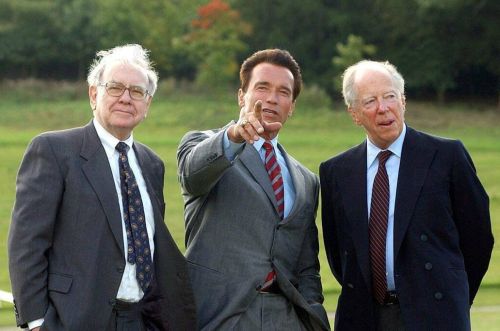
Setting: A quiet, opulent lounge at a charity event in Monaco, 2002. The murmur of wealthy guests fills the air.

Characters:

  • JCJ (Joseph C. Jukic): Observant, sharp, with a knowing smile.
  • Arnold Schwarzenegger: Relaxed, but with the keen awareness of a public figure. A glass of mineral water in his hand.

(JCJ leans slightly towards Arnold, nodding discreetly towards a distinguished older gentleman in a impeccably tailored suit holding court across the room.)

JCJ: You see that man over there, Arnold? The one speaking with the curator?

Arnold: (Squints slightly, then nods) Lord Rothschild. Of course. A powerful man. Very connected.

JCJ: Exactly. The richest man in Babylon. The king of his particular mountain. It’s an old world, that one. All quiet handshakes and generational influence.

(Arnold turns to JCJ, intrigued by the tone.)

Arnold: And what mountain are we on, Joe?

JCJ: (Chuckles softly) A louder one. A brighter one. One with explosions and one-liners that echo in every kid’s head from Detroit to Delhi. Seeing him just now made me think of you.

Arnold: (Raises an eyebrow, a playful smirk forming) What, you want me to start wearing a pinstripe suit and buy a bank? I tried putting on a tie for Junior. It didn’t work.

JCJ: No, no. Nothing like that. Think about it. He is the absolute pinnacle of his world. The archetype. When people think of that kind of immense, almost untouchable financial power, they think of a Rothschild.

(JCJ pauses, letting the comparison hang in the air.)

JCJ: And when anyone, anywhere on this planet, thinks of an action star… the biggest, the best, the very definition of the word… they think of you. You are the Rothschild of action.

Arnold: (Leans back, his smirk softening into a genuine, thoughtful expression. He lets out a low grunt of appreciation.) Hah. That’s a new one. I’ve been called the Austrian Oak, the Governator… never that.

JCJ: It’s true. You didn’t just play the part; you built the genre. You are the kingdom. And that’s why I say you’re not just the biggest. You are possibly the last action hero.

Arnold: (Nods, his voice dropping to a more reflective tone) The last? Because the world is changing.

JCJ: Exactly. It’s all becoming green screens and wirework. Anyone can be a hero if the pixels are good enough. But what you did… that was physical. It was palpable. It was real. Like old money versus new money. There’s a weight to it. A substance. They can make a thousand action stars now, but they can’t make another you. The era of the one-man empire… the king… is ending.

(Arnold looks out over the glittering crowd, then back at JCJ. He raises his glass of water.)

Arnold: To kings, then. In all their kingdoms. The quiet ones…

(He gestures with his glass towards Lord Rothschild.)

Arnold: …and the loud ones.

(He taps his glass gently against JCJ’s.)

JCJ: To the last king of Babylon.

Arnold: (A wide, iconic grin finally breaks across his face) I still like the sound of that. But the night is young. Maybe I’ll go say hello. See if he wants to be in a movie. I have a script about a banker who fights aliens…

JCJ: (Laughing) Now that’s a handshake I’d pay to see.

(They both laugh, the sound cutting through the dignified hum of the room, two men perfectly aware of their respective domains.)